Land Tenure and the Credit Divide
Author
Mlamisi Mdluli
Contributor
Published
Reading time
In Eswatini a house can be solid, occupied for generations, and still unbankable. Title status, not income, is what decides who gets a mortgage.
Two systems, one country
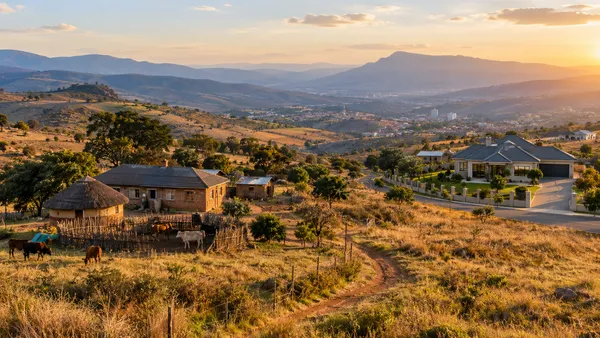
Property ownership in Eswatini runs on two parallel tracks, and the difference between them still decides who can walk into a bank and who cannot. Title Deed Land, concentrated mainly in urban centres and gazetted areas, offers registered, transferable ownership that lenders recognise as bankable collateral. Swazi Nation Land covers most of the country's landmass and hosts a large share of the population. It is allocated through chiefs and traditional structures, granting occupation and use rights rather than freehold title. The split is not only about custom or governance. It is about whether the place you live in can ever become security for a loan.
What a bank can actually take
Financial institutions need security they can register, value, and if necessary repossess. A Title Deed property fits that framework. A homestead on Swazi Nation Land—however solid the walls, however long the family has lived there—generally does not, because the land itself cannot be pledged or sold in the conventional sense. That is the practical hinge of the credit divide: not whether the house is “real,” but whether the bank has a legal path to treat it as collateral.
The gap follows the map
The financing gap tracks almost exactly with where people live rather than what they can afford. Families on Swazi Nation Land who want to expand a house, add a rental room, or start a home-based business often find mainstream lending closed to them regardless of income stability or repayment capacity. The need for capital does not disappear. It is rerouted—toward savings clubs, family contributions, and cash-as-you-go building, the same informal patterns that quietly finance far more Eswatini homesteads than mortgage statistics ever show. Construction proceeds when money arrives, not when a loan product says it should.
Reform without replacing chiefs
Land administration reform conversations in Eswatini keep returning to this tension. Proposals for occupancy certificates or leasehold instruments on Swazi Nation Land aim to create documentation banks might eventually recognise, without converting traditional allocation into freehold. Progress has been gradual for a reason. Reform that ignores chieftaincy structures—still central to how land is allocated and inherited across most of the country—will not stick. The hard problem is documentation that bridges systems, not paperwork that pretends one system can simply replace the other.
Where formal development shows up
The divide also shapes where formal development concentrates. Title Deed areas attract more visible investment, structured valuations, and an active resale market because ownership can be verified and transferred with legal certainty. Swazi Nation Land settlements, despite housing so many people and holding enormous cumulative value in structures and improvements, remain largely outside the formal valuation and lending economy. The result is a strange asymmetry: the built environment on traditional land can be substantial and well established, yet financially invisible to banks—and, by extension, undercounted in national pictures of property wealth.
Two property logics in one life
There is a generational layer as well. Younger Swazis increasingly move between both systems across a lifetime—renting or buying in town on Title Deed land during working years while retaining ties to a homestead on Swazi Nation Land. Their financial planning has to hold two property logics at once: one governed by registries and mortgage instruments, the other by custom and community relationships. Few products currently speak to that dual reality in any integrated way.
Bridge, do not replace
As reform discussions continue, the property sector would benefit from instruments that bridge rather than replace the two tenure systems. Certificates of occupation, community-backed guarantee schemes, or hybrid leasehold products could eventually allow value built on Swazi Nation Land to be recognised without requiring full conversion to Title Deed status. Until such mechanisms mature, the credit divide will remain one of the most consequential yet underexamined features of Eswatini’s property landscape—quietly determining who builds with borrowed capital and who builds only with what has already been saved.